Communication Strategy: Bridging Science and Scientific Communication
Most practitioners excel in one domain. I operate fluently across both.
Here’s how:
Understanding the Difference
Most people use "science communication" and "scientific communication" interchangeably. They shouldn't.
Science communication is public engagement — podcasts, museum exhibits, popular writing. The skills are narrative construction, media production, public trust building, and sometimes viral optimization.
Scientific communication is professional translation — training, documentation, stakeholder briefings. The skills are regulatory compliance, technical writing, cross-functional alignment, and business outcome translation.
These domains share fundamental skills, but each domain also requires unique expertise.
The Skills Framework
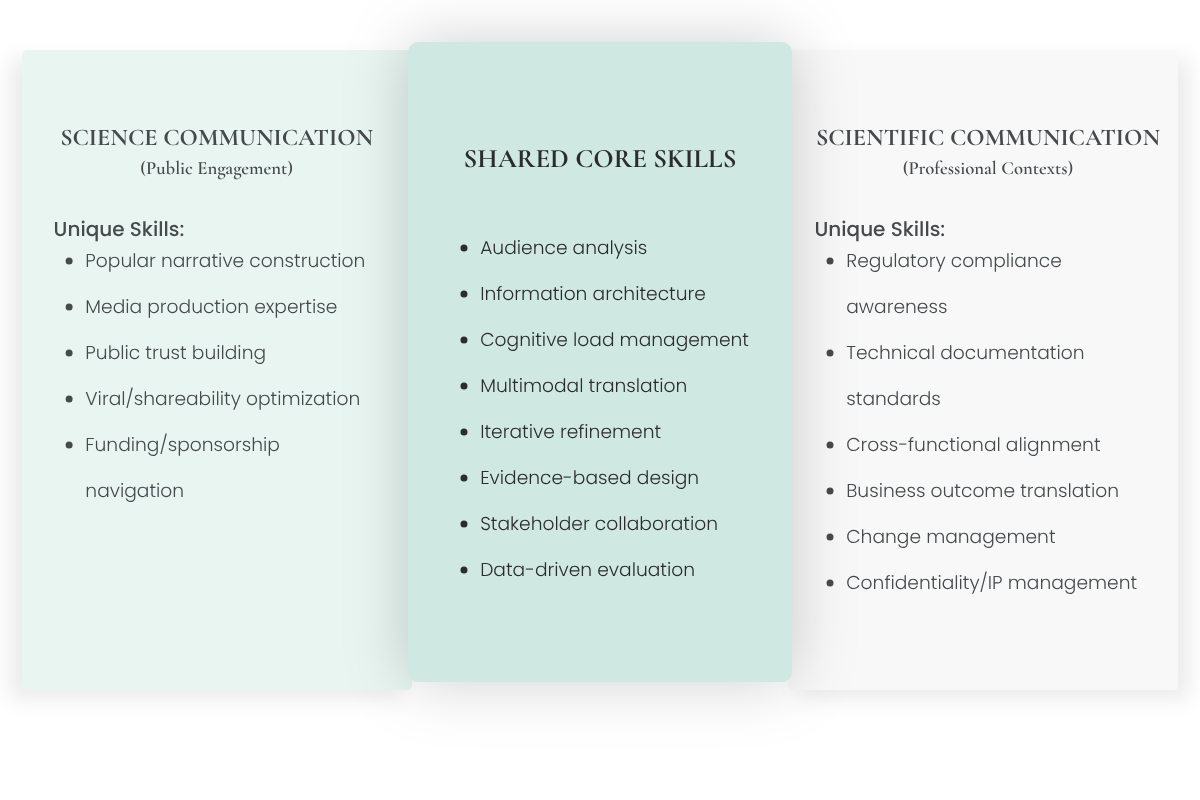
I work fluently across both domains - birding gaps many practitioners can’t.
How I Approach Communication Strategy
-
Before I create any training, media, or documentation, I map:
Who needs this information?
What mental models are they bringing?
What psychosocial dynamic are in play?
Which format matches their context?
Example: When I create training for technical experts, I’m not just teaching content. I’m managing their identity as “the expert” while at the same time asking them to operate differently. That’s not just an information challenge, it’s a psychosocial one too.
-
Effective communication considers format. The medium shapes the message.
I work across:
Long-form audio
Short-form video
Written content
Live experiences
Immersive media
Each format has different cognitive affordances - that’s what the medium naturally makes it easy or hard for the brain to do.
Audio lets you build intimacy, but try explaining a complex diagram through audio alone? You’re fighting the medium.
Video shows you how something works in motion. But if you need to reference step 2 later, scrubbing through a video is cognitively expensive.
The question I ask is “What does this information need in order to land with this audience?”
-
Science communication and learning design share foundational skills:
Backwards design - start with what the audience needs to do, not what you want to tell them
Cognitive load management - unnecessary complexity is the enemy!
Formative assessment - how do you know if it landed?
Iterative refinement - test, learn, adjust
Grounded in the Science of Learning
My approach to communication isn’t just intuition. It’s grounded in the science of teaching and learning.
I came to this work through a background in molecular biology and genetics. As a PhD student, I wasn’t just studying mechanisms of DNA replication - I was learning how to construct knowledge, test mental models, and communicate findings.
I completed a teaching postdoc, further shaping my approach to teaching and learning for undergraduates. I worked as an assistant professor, then moved on to directing a scientific training program for adult learners.
Those experiences shaped how I think about translating complexity.
Novice Understanding & Expertise are Structured Differently
Experts organize information around deep principles while novices organize around surface features. If you explain something the way an expert understands it, you’ve likely lost the novice.
Learning Goes Beyond Exposure; It Requires Retrieval
You don’t learn just by hearing information. You learn when you actively retrieve and use it. This is why I design exercises, opportunities to use info, into everything I create.
Cognitive Load is Real
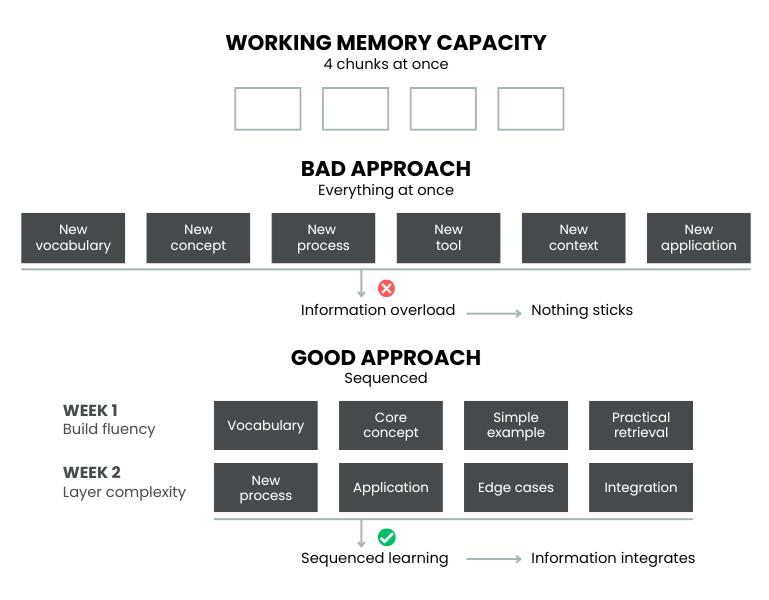
Your working memory can hold ~4 chunks of information at once. If I’m asking you to learn new vocabulary AND new concepts AND new processes simultaneously, you’ll retain none of it.
This is why I carefully sequence information. I share one new thing at time. I build fluency first, then layer in the complexity.
Where I’ve Applied This
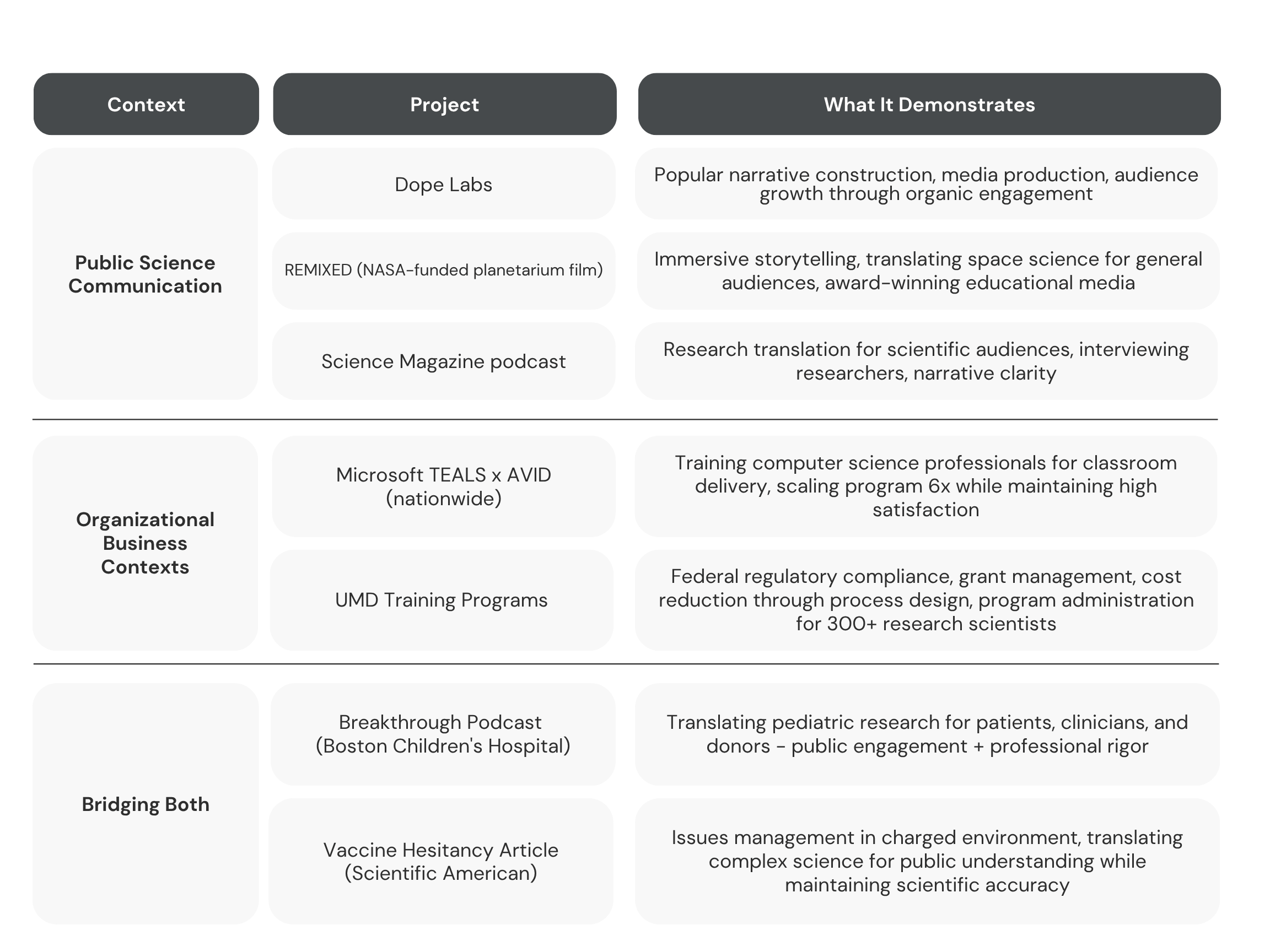
These are the same skills used with different stakeholders — audience analysis, psychosocial awareness, format selection, and precision in translation.
Why This Matters for Workforce Development
If your organization is facing:
→ Technical talent who can't communicate to business stakeholders
→ Cross-functional teams where domain experts talk past each other
→ Training programs that don't change behavior
→ Change initiatives where the "why" doesn't land
...you don't have a knowledge problem. You have a communication problem.
What I help organizations do:
→ Train technical experts to communicate with non-technical audiences
Not "dumbing down" — precision in translation while maintaining expertise
→ Design learning experiences that account for psychosocial dynamics
Understanding identity, power, and motivation alongside information architecture
→ Build communication capacity (not just deliver one-off content)
Developing internal capability, not just outsourcing to consultants
→ Select formats that match audience context
Not defaulting to courses when documentation, workshops, or other modalities would work better
I WORK WITH CLIENTS ON:
AI adoption and implementation in learning design
Training program scaling (100+ to 1,000+ participants)
Research translation for decision-makers
Scientific communication strategy for HCP education
Cross-functional communication and stakeholder alignment
Downloadable Frameworks
These frameworks are free to use. Download them, share them with your team, and adapt to your context. If you find them useful, please connect with me on LinkedIn or share them with others who might benefit.
Audience Architecture Canvas
Stakeholder mapping for complex communication contexts
When to Use: Multi-audience training, research translation, cross-functional communication strategy
Work With Me
I help organizations build communication capacity, scale training programs, and implement AI tools thoughtfully.