What If Your Body Could Stream Its Own Data?
Have you ever realized you have an appointment for a physical coming up and just known that it doesn't represent the full picture? Maybe you've slacked off on exercise in the past few months, or maybe for eight of the last twelve months you were eating poorly and now you've cleaned your diet up.
So much rests on this single snapshot at the physical, but what if we could get continuous snapshots? A way to almost livestream our body based on small proteins that can give us clues about what's happening.
A Stream, Not A Snapshot
I covered a review article titled "From reactive to proactive: Continuous protein monitoring for preventive health care" for Science podcast, and I interviewed the first author, Jane Donnelly to learn more about the vision she and her team have for the future of this field.
(A review article is different from an original research report. It synthesizes what's known, names what's still unknown, and maps where discovery might head next. This was my first review for Science Podcast; everything else I've covered for them has been original research.)
Jane and her colleagues are imagining a future where sensors on or in your body continuously monitor proteins, which are the molecular actors that drive what's happening in your body. Instead of a single snapshot from bloodwork once a year, you'd have an ongoing stream of data about what's changing inside you.
Why this hits home
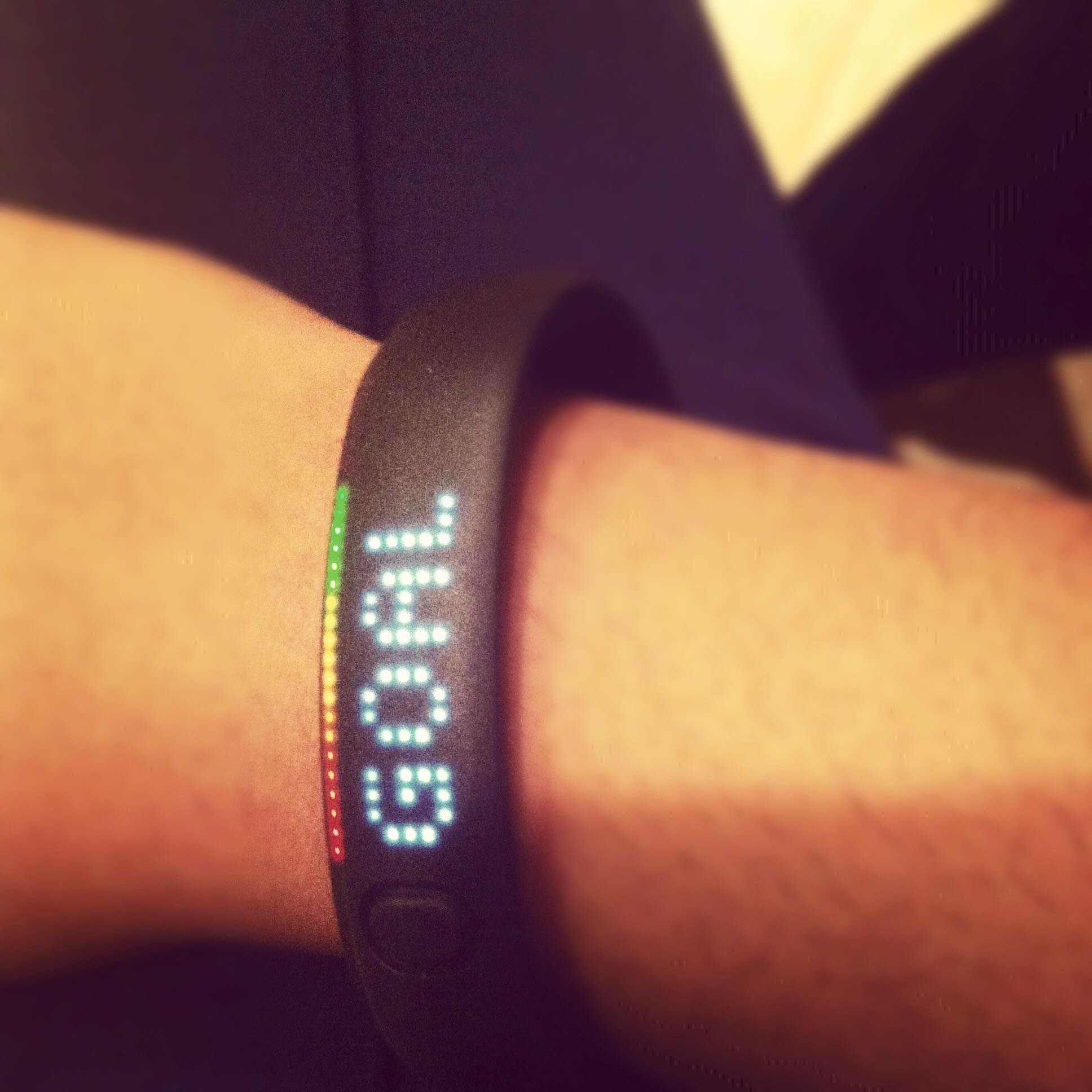
My Nike Fuelband from 2012. This was cutting edge wearable technology at the time!
Now, I am a data nerd. If there's more data to be collected, I want to see it! I was an early adopter of the Nike Fuelband, the FitBit, the Apple Watch, and the Oura Ring. Earlier this year, I talked to Chris Mims of the Wall Street Journal about wearable tech and what we'll do with all that information in an episode of Dope Labs. These devices read heart rate and blood oxygen levels, but what if they could capture rapidly (or slowly) changing protein signals, detecting previously unmonitored changes in my body? I met this work with great excitement, curiosity, and a little skepticism about what it meant in practice.
The Constant Calibration
A large portion of Science Podcast listeners might be scientists, but they're not all biologists. They might be physicists or geologists or engineers who haven't thought about molecular biology since an introductory course.
Molecular biology has been my world for over 15 years, but it's not something you can see or hold. You can't point to a protein the way you can point to a bone or a muscle. So I've often relied on analogies when I'm teaching or explaining because they give people something to anchor to.
In this interview, I used television as my anchor. I told Jane that continuous monitoring felt like the shift from watching one episode a week to always-on streaming. Instead of a single snapshot at your annual physical, you get the full story in real time. She loved it enough to say she'd use it in her own presentations.
Not everyone listening knows what continuous glucose monitoring is or how it works. But almost everyone understands the difference between waiting a week for the next episode versus having the whole season at your fingertips. If I can anchor the science to something familiar, my audience has an entry point — and then Jane can take them deeper.
The Harder Questions
The promise of continuous protein monitoring is exciting, but there are real hurdles ahead. Jane and I talked about a lot that didn't make the final edit. We talked about the potential for AI to handle massive datasets, the need for training clinicians to interpret continuous data, questions about where it's stored and for how long and who has access. These aren't small problems.
What did make the cut was our conversation about the psychology of it all. There's often a long delay between what we do and when we see the results. You change your diet and maybe you notice weight loss, but you won't know if it's moving your bloodwork in the right direction for months. You take your medication, but you're trusting it's doing something you can't feel. Continuous monitoring shrinks that window and you get feedback closer to the action.
When I raised this with Jane, she said she hadn't thought about it that way. That moment is one of my favorite parts of the conversation. She brought the science. I brought a different lens. And together we landed somewhere neither of us would have arrived alone.
The segment aired on Science Podcast and was later covered in ScienceAdviser.
This is the work I love: finding the angle that makes complex science click, asking questions that let researchers speak directly to an audience, and occasionally offering a lens that adds something new to the conversation. If you're looking for someone to translate your research, host your podcast, or bring story and data together for your next project, let's talk.